
Foe

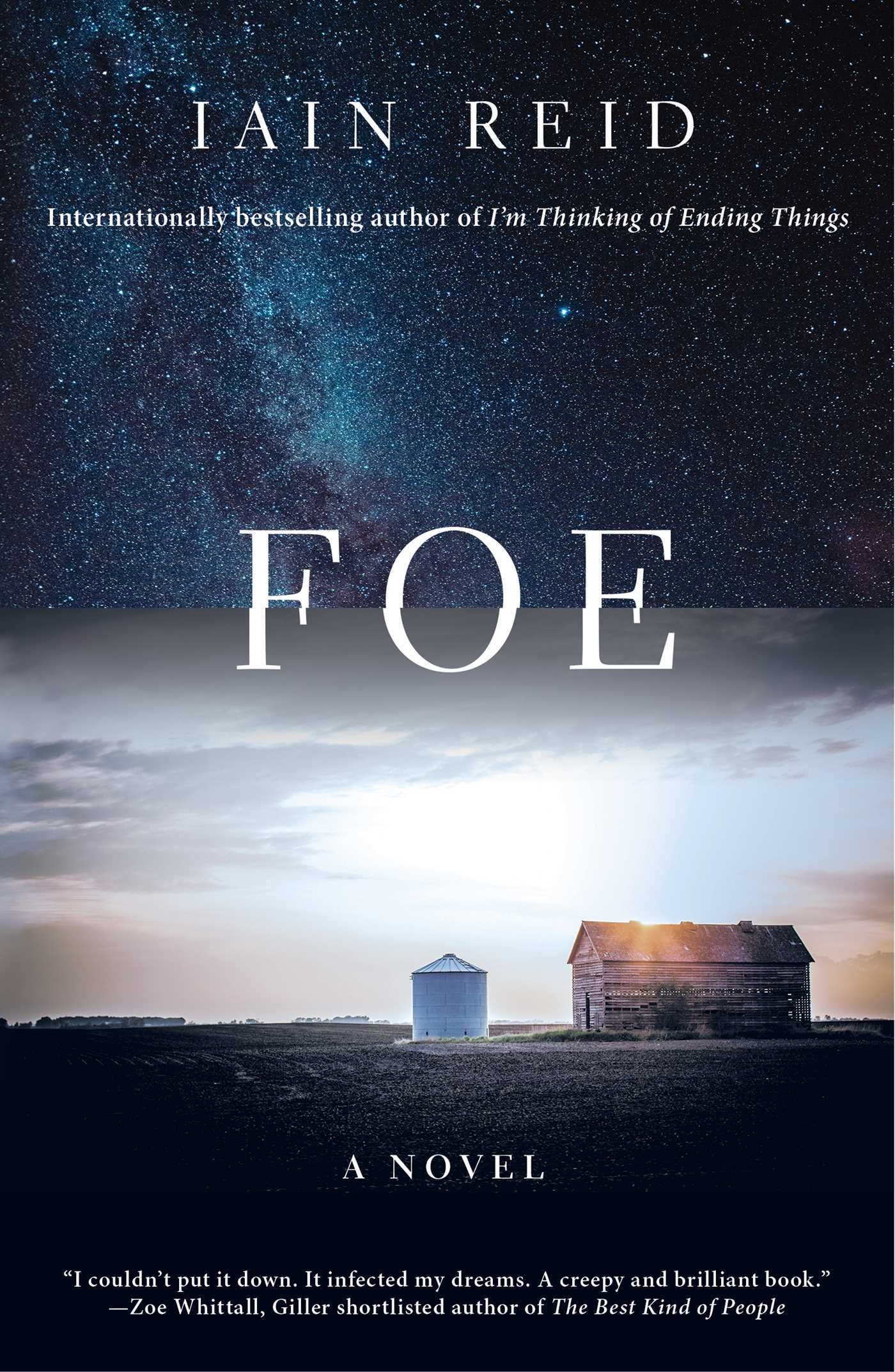
This month we went a bit rogue and picked up a science fiction psychological thriller, which was adapted into a movie starring book club favorites Paul Mescal and Saoirse Ronan. Junior and Hen are a couple living an isolated life out on a farm, until one day a man shows up and informs them that Junior has been selected to be on the shortlist of people who may go into space for a science experiment. Luckily, the company sending him to space has promised that they will give Hen a robot replacement of Junior to keep her from feeling lonely. But first, they just have to run some tests… —Caroline Tew
Aline
One of my favorite things in this world is the joyful surprise of having read a book or watched a movie that you didn’t expect to like and finding you had a great time consuming it. I don’t typically like sci-fi or media related to space. I don’t have an answer as to why, other than I find everything going on Earth so much more interesting. For this reason I was delighted to read “Foe” — I was excited to have my mind changed. Unfortunately, the characters and the writing simply didn’t impress me.
Through the pacing the writer was able to keep feeding the suspense, which initially made me feel invested. Yet the more I read the more I found the character development sorely lacking. Because the story is told through Junior’s POV but so much of the action is propelled by Henrietta’s feelings and choices, I found that I was missing her perspective entirely. I wonder why the writer didn’t devote a chapter to her at least. Even if he felt like he’d be spoiling the twist (which is so obvious), the reader would have benefited from tracking her thoughts. It’s also hard to portray a domestic relationship without both sides of the story, so even on a structural level I think this story could have used the “other side.”
I was also disappointed to find that the world wasn’t richer and the stakes weren’t higher. There were so many opportunities to explore a really interesting set-up. I was left with so many questions: why are people sent into space? What happens if someone refuses? I know that wasn’t the point of the novel, but I think it would have felt more like sci-fi if the author had spent the time world building. I can see why someone would enjoy the thrill of this story, but honestly, this feels like an empty attempt at philosophical musings on relationships and love.
Caroline Tew
It’s no secret (well, maybe it is for our readers) that I am a scifi girlie. So when we learned that Paul Mescal and Saoirse Ronan were going to be in the movie adaptation of Foe, I jumped on the chance to con my fellow book club members into reading a genre novel. As the resident scifi representative I would just like to make it clear that I do not recommend Foe. If for whatever reason you liked it, I’m happy for you, but if you’re not a genre reader, pretty please don’t let this be the one sff book you pick up. Because it is bad.
Before I say why the book was bad, let me just say this: even the very basic premise makes no sense. A lifelike robot is super advanced tech to have just to waste it on keeping these random people company; make Hen go visit friends or rot peacefully in her own home or whatever.
Basically, what happens is that the sci-fi elements aren’t particularly compelling, nor are they explored in any new or interesting way. But the most egregious sin is that it’s not even a very good thriller. The twist, which happens in the final 10%, was so obvious to me that I figured it was something that we, the reader, knew, but our narrator did not. I was expecting it to be discovered and be a fun little midway twist, that would kick off a series of consequences and, dare I dream, more twists. I was imagining a book far more intriguing than anything we were actually given. The worst part is, the whole book is just a vehicle for the author to deliver a wow-moment…which only made me gasp upon reading because I realized I just read over 200 pages for nothing.
You can’t tell me I’m wrong, either. The movie bombed (like, I literally couldn’t find a theater in Manhattan showing it just two weeks after it aired) and is sitting at a crisp 24% on Rotten Tomatoes despite starring some Grade A actors. Which can be attributed to the poor source material. I digress.
Caroline Tsai
Those of us who have lived in the Midwest understand that it is the kind of place you fantasize about escaping, whether that means moving away for college or becoming the guinea pig for a sinister tech corporation’s bio-mechanical humanoid robot experiment and getting blasted to space while your AI double lives your regular life for you. You know, either one. In Foe, Junior doesn’t choose the latter path, so much as he is gently coerced. The coercer in question is Terrence, an enigmatic representative from the aforementioned sinister big tech company, who assures him this is an exciting opportunity that he’d be foolish to reject. No more questions. Now take off your pants so we can 3D-scan your junk.
Why, exactly, this experiment is actually taking place is not of interest to Reid, who seems content with a speculative fiction version of Scenes from a Marriage. But come to think of it, nor is the marriage itself. Hen is a real Christopher Nolan Dead Wife ™, appearing in fragmentary visions and memories in thin cotton sheath dresses and dispensing little trinkets of wisdom to Junior. “It doesn’t matter what I would do,” she offers in a scene where Junior considers taking a job. “I’m not the one doing the job. Try answering this: What do you want?” You can feel Junior’s wistful longing for this nicer, more selfless Hen, as much as you lack any shred of Hen’s subjectivity at all.
Ceding away her desire has not served her well. Present-day Hen is “erratic at times, frustrating, unpredictable, and, recently, standoffish,” which frustrates Junior, who feels increasingly like he’s being cuckolded by Terrence, who… moves in for some reason? Most of the plot events of the novel are justified by nothing more than an authorial shrug, chugging along simply because it’s the next most interesting narrative move. There’s little mention of the crisis that precipitated such drastic measures, nor who exactly stands to benefit from the human-robot scheme. Perhaps all of this could be forgiven if we could buy into the complexity of the marriage itself, but that’s not particularly compelling either. One partner is clearly dissatisfied; the other has an infantile grasp of their marital affairs; never the twain shall meet. “They stay together because it’s expected, because it’s what they know,” Hen ruminates. “They try to make it work, to endure it, and end up living under some kind of spiritual anesthetic. They go on, but they are numb. And the more I think about, the more I think there’s nothing worse than to live your life this way. Detached, but abiding. It’s immoral.”
What’s immoral is making Paul Mescal bust his cute little Lir Academy-trained ass to deliver an impassioned monologue about his repulsion by human snot. Yes, we watched the movie. Yes, it is bad. If only a humanoid robot could have watched it for me.
Looking ahead… Next month (we promise!), we’ll be diving into Zadie Smith’s new book, The Fraud.